
Profile
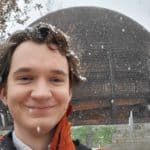
Zak Williams
-
About Me:
I am a physics PhD student at the University of Bristol (currently working at CERN).
I’m originally from Sheffield.
-
My pronouns are:
he/him
-
My Work:
I am an experimental particle physicist precisely measuring how very rare and heavy particles decay, looking for unreported signals!
-
Read more
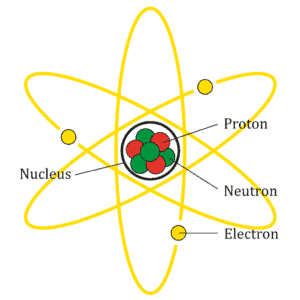
^^^^^^^^A diagram of an atom^^^^^^^^
You might have heard of ‘atoms’. They’re incredibly small (far too small to see with the naked eye or with a regular microscope), and they make up all stable matter we interact with in our day to day life.
You might even have heard of protons and neutrons, which make up most of the weight of an atom (more than 99.999% of it)! Well these protons and neutrons are made of even smaller particles called quarks. Quarks are thought to be ‘fundamental’, meaning they are the smallest things there is, they can’t be broken down any further!
These quarks can come in different types, some of which are very rare and very heavy (over 77 thousand times heavier than the most common sort that make up everyday matter)! Heavy quarks are very unstable, and want to change into their lighter versions to become more stable.
By studying how specific types of rare heavy quarks decay, we improve our understanding of lots of open questions in physics you might have heard of including the mystery of dark matter, the imbalance of matter and antimatter in our universe, and look for new fundamental particles not yet observed!
I work on precisely measuring the nature of these changes in quark types, referred to as decays (‘decay’ is used to refer to an occasion where a heavier particle changes into a lighter one).
For people who know more that I did at that age: I’m studying “bottom/beauty to strange semileptonic penguin decays” 🐧, profiling the angular and invariant mass (energy) decay distributions. Profiling the decay will include measuring the known (Standard Model) contributions, matter-antimatter asymmetries, and particularly scalar and pseudoscalar contributions that haven’t yet been observed.
Later on in my PhD I will help in the alignment of mirrors within the detector we use to measure these rare decays!
The “experimental” in experimental particle physicist means I am responsible for helping to maintain/perform experiments, and process and understand the meaning of their results.
-
My Typical Day:
I wake up at 7-7:30 am.
I walk up a big, steep hill, and then a lot of stairs to get into the office.
I often leave to get lunch with friends at about midday, and get back to my desk at about 1.
I most often leave the office at 5:30-6pm.
-
Read more
I wake up at 7-7:30 am.
I walk up a big, steep hill, and then a lot of stairs to get into the office.The office I work in is for 1st and 2nd year PhD students (and research master’s students), but because all the 2nd year PhD students are on their long term placements at the site of their experiments I only share it with other 1st years.
Currently in the morning on Mondays and Tuesdays I have taught modules for new PhD students. The rest of the week is dedicated to revision and progression in my core PhD project. Every Friday morning I have a meeting with all the people at my university on my experiment (the Bristol LHCb team). After lunch on Mondays I meet with my supervisor.
The bulk of my moment-moment work consists of programming, writing notes/work in a document formatting tool called LaTeX (like a more advanced version of Microsoft Work), or doing particle physics/quantum mechanics calculations.
I most commonly leave the office at 5:30-6:00pm. Sometimes a little earlier, sometimes a bit later depending on how my work has gone throughout the day.
-
Education:
Yewlands Academy (2012-2017) – GCSEs.
Chapeltown Academy (2017-2019) – A levels (Maths, Further Maths, Physics, Chemistry).
University of Warwick (2019-2023) – MPhys (Physics).
University of Bristol (2023-…) – PhD (Physics).
-
Qualifications:
GCSEs: Mathematics, Physics, Chemistry, Biology, History, English Literature, English Language, Geography, Religious Education
A-Levels: Mathematics, Further Mathematics, Physics, Chemistry
Undergraduate: MPhys Physics
-
Work History:
2022: (Summer) Internship at WMG
2017: (2 Weeks) work placement at BDP architects
-
Current Job:
PhD Student/Researcher
-
Employer:
University of Bristol
-
My Interview
-
What did you want to be after you left school?
Physicist (lucky me!)
Were you ever in trouble at school?
On occasion
If you weren't doing this job, what would you choose instead?
Training to be an architect
-